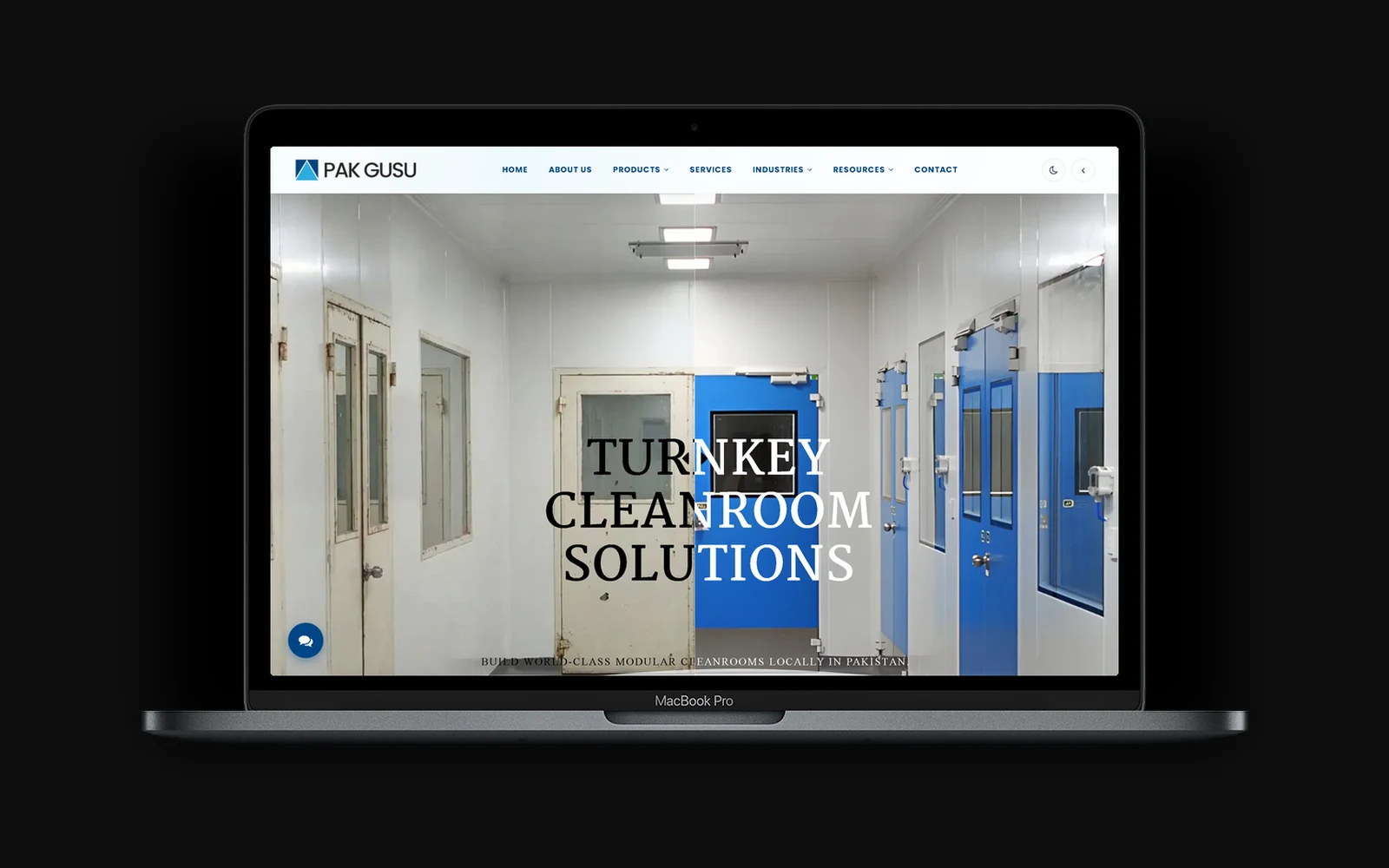
Most of our case studies focus on dashboards, APIs, and mobile apps. This one is about something deceptively simple: a marketing website. But "simple" is the wrong word for a B2B site that has to load instantly on a patchy connection in the Gulf, rank for competitive industrial keywords, serve two languages, and turn a casual visitor into a qualified sales lead. Here is an honest look at the engineering decisions behind a recent project for an industrial manufacturer and exporter.
The brief: an exporter selling into the GCC
The client manufactures modular cleanrooms and components in Pakistan and exports them across the six GCC states. Their buyers are procurement managers, project engineers, and consultants in pharmaceutical, food, electronics, and healthcare facilities. That audience does not respond to glossy fluff. They want to confirm, quickly, that a supplier understands the standards they are bound by, can ship to their port, and can support validation. You can see the result on the live site, pakgusu.com, and every choice below was made to serve that specific buyer.
Three constraints shaped the build from day one: speed, discoverability across multiple national markets, and trust. We will take each in turn.
Why we chose static HTML for speed
It is tempting to reach for a heavy CMS on every project. We deliberately did not. A content-managed stack with a database, plugins, and a theme layer adds runtime cost on every page view, and most of it is wasted on a brochure-style site whose content changes weekly at most.
Instead we built the site as static HTML, with a small, scripted build process that generates pages from structured content files. The payoff is direct: there is no database query between a visitor's request and the first byte of HTML. Pages can be served from cache and edge locations, which matters enormously when a meaningful share of your traffic comes from the UAE and Saudi Arabia rather than from down the street.
Static does not mean primitive. We still run a generator that stamps consistent metadata, navigation, and structured data across dozens of pages, so a single change propagates everywhere. The result is the maintainability of a templated system without the per-request overhead.
Structured data so search engines understand the business
For a B2B manufacturer, organic search is the cheapest qualified traffic available, so search visibility was not an afterthought. Beyond the usual on-page basics, we invested heavily in schema markup, the structured-data vocabulary that tells search engines what each page actually represents.
- Organisation and LocalBusiness schema to describe the company, its location, and contact points consistently.
- Product schema on each equipment page so panels, doors, pass boxes, air showers, and filter units are recognised as distinct products.
- FAQPage schema on key pages, which doubles as answer-engine fodder. The visible questions and the marked-up questions are kept identical, because mismatches are a common cause of rich-result errors.
- BreadcrumbList markup to reinforce site structure.
A practical note for anyone replicating this: validate every block. We treat a JSON-LD validation pass as a release gate, the same way we treat a failing unit test. Invalid structured data is worse than none, because it erodes trust signals.
Multilingual and geo landing pages, done honestly
Selling into the GCC means buyers who search in both English and Arabic. We built native Arabic pages with proper right-to-left layout, rather than bolting a translation widget onto English markup, and wired reciprocal hreflang annotations so each language version points cleanly at its counterpart.
We also created geo landing pages for individual markets and cities. These are not doorway pages full of swapped place names. Each one carries genuinely market-relevant context: the regulatory bodies a buyer in that country answers to, shipping realities to the nearest port, and the specifics that make the page useful to a real reader. The honest framing matters as much as the SEO: the site is clear that the manufacturer is based in Pakistan and exports into the region, and it does not claim local offices or certifications it does not hold. Accurate content ages well; exaggerated content invites a correction you do not control.
Lead capture that fits the sales process
Traffic is meaningless if it does not convert into a conversation. We built quote-request forms with sensible validation, spam protection through a honeypot field and rate limiting, and server-side delivery that routes each enquiry to the right inbox. Crucially, every submission carries a hidden source field recording which page and campaign produced it, so the sales team knows whether a lead came from an Arabic geo page or a product spec sheet. We also instrumented a conversion event in analytics on every successful submission, which closes the loop between marketing effort and pipeline.
What we would tell another exporter
You do not need a heavyweight platform to compete in search. A fast static foundation, disciplined structured data, genuinely localised content, and instrumented lead capture will outperform a bloated template on the metrics that matter to a B2B seller. The harder work is editorial honesty: writing pages that are accurate enough to earn a buyer's trust on the first visit. That is the part no framework solves for you, and it is where we spend the most time.
Frequently Asked Questions
Why build a B2B export website as static HTML instead of a CMS?
For a brochure-style B2B site whose content changes weekly at most, a database-backed CMS adds runtime cost on every page view for little benefit. Static HTML, generated from structured content files by a small build process, means there is no database query between a visitor's request and the first byte, so pages can be cached and served from the edge. That matters when a meaningful share of traffic comes from the UAE and Saudi Arabia.
How do you do multilingual and geo SEO for the GCC without spammy doorway pages?
We build native Arabic pages with proper right-to-left layout rather than a translation widget, and wire reciprocal hreflang so each language version points at its counterpart. Geo landing pages carry genuinely market-relevant context, such as the regulatory bodies a buyer answers to and shipping realities to the nearest port, rather than swapped place names. Honest, useful content ages well; exaggerated content invites a correction you do not control.
Is Pak Gusu based in the Gulf?
No. Pak Gusu Technology is a cleanroom manufacturer based in Lahore, Pakistan, and the technical partner of GUSU Purification (China). It designs, manufactures and exports modular cleanrooms and components to the six GCC states; its systems are designed to meet ISO 14644 and EU-GMP and are validation-ready. The website is explicit that the company is Pakistan-based and does not claim Gulf offices or certifications it does not hold.
Want help with this? Apex IT Solutions builds custom software, web, mobile apps, and DevOps for B2B clients in the US, UK, UAE, KSA, Canada, and Pakistan. Talk to an engineer for a free consultation.