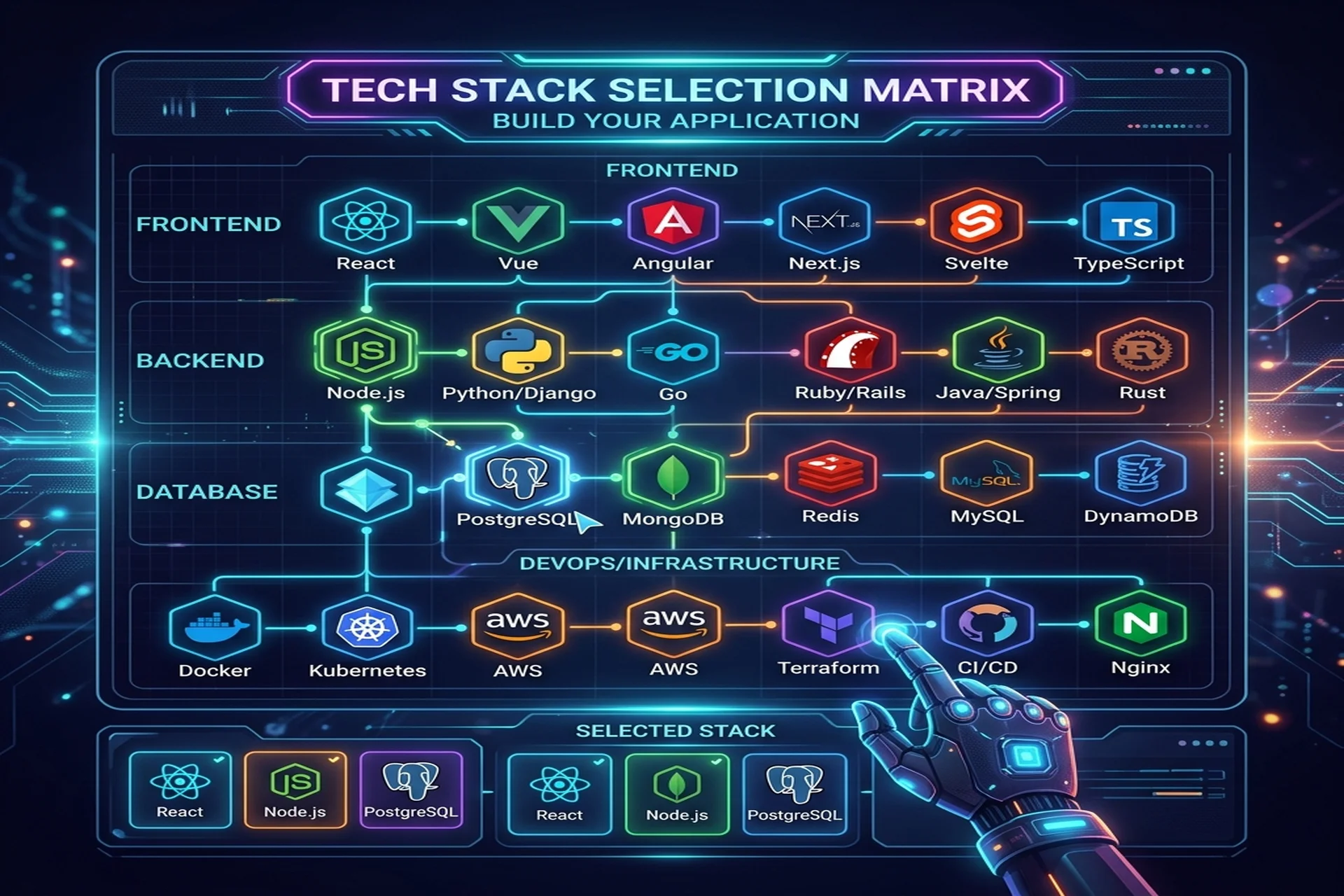
Choose a tech stack by matching it to your team's skills, your expected scale, your local hiring market, and the maturity of the ecosystem — not by what is trending or what looks impressive on a resume. For most web products, a safe default is Next.js on the frontend, Node.js (or another mainstream backend language) on the server, and PostgreSQL for the database, deployed on a managed cloud. That combination is popular because it is easy to hire for, deeply supported, and scales from a first prototype to millions of users. It is a sensible starting point — not the only correct answer. This guide walks through how to reason about each layer so you make a choice you will not regret in two years.
What a "tech stack" actually means
A tech stack is the set of technologies your product is built on, usually grouped into four layers: the frontend (what users see and interact with), the backend (the server-side logic and APIs), the database (where data lives), and the infrastructure (where and how everything runs). Each layer has dozens of credible options, and the art of application development is choosing a combination that fits your specific situation rather than chasing the newest tool. The stack you pick shapes your hiring, your delivery speed, your operating costs, and how easily you can grow.
The four factors that should drive your decision
Before you compare specific frameworks, score every candidate against these four factors. They matter far more than benchmarks or feature lists.
- Team. What does your current team already know deeply? A technology your engineers are fluent in beats a "better" one they have to learn on the job. If you are hiring a dedicated development team, ask what they are genuinely strongest in.
- Scale. Be honest about where you need to be in 12-24 months. Most products never reach the scale that justifies exotic architecture. Pick something that handles your realistic load with room to grow — see our glossary entry on scalability for what that really requires.
- Hiring. Can you find and afford engineers for this stack in your market? A niche language with a tiny talent pool becomes a liability the moment a key person leaves.
- Ecosystem. Mature stacks come with libraries, documentation, hosting support, security tooling, and answered questions. A thin ecosystem means you build (and maintain) more yourself.
Choosing the frontend
The frontend is the easiest layer to change later, so do not over-agonize here. For most content-and-app hybrids, a React-based framework like Next.js is a strong default: huge talent pool, excellent server-side rendering for SEO, and first-class hosting. If your product is a simple marketing site or content platform, a lighter approach to website development may be cleaner than a full single-page app. The deciding questions are: how interactive is the interface, how much does search visibility matter, and what does your team already write confidently?
Choosing the backend
The backend is where business logic lives, so language choice has long consequences. Node.js (JavaScript/TypeScript) is a common default because it shares a language with the frontend, simplifying hiring and code sharing. But it is far from the only good choice — Python, Go, Java, C#, and PHP all run enormous production systems. Pick based on your team's depth, the available libraries for your domain, and the hiring market, not on micro-benchmarks. A boring, well-understood backend that your team ships reliably is worth more than a fashionable one they fight.
Choosing the database
The database is the hardest layer to change later, so spend your care here. A relational database like PostgreSQL is the right default for the large majority of products: it handles structured data, transactions, complex queries, and analytics, and it has decades of tooling behind it. Reach for a document store, key-value cache, or search engine only when a specific access pattern clearly justifies it — and usually alongside your relational database, not instead of it. Resist the urge to adopt three databases on day one to keep your operational surface small.
Choosing the infrastructure
Start simpler than you think you need. A single well-structured application on a managed platform (a managed container service, serverless functions, or a platform-as-a-service) will carry most products comfortably for a long time. You do not need microservices or Kubernetes to launch. When real scale or team size demands it, mature DevOps and cloud practices — infrastructure as code, CI/CD, observability, and container orchestration — let you grow without rewrites. Add operational complexity when the pain is real, not in anticipation of it.
Avoid resume-driven development
The single most expensive mistake in stack selection is resume-driven development: choosing a technology because it is trendy, intellectually exciting, or good for an engineer's CV, rather than because it serves the product. The newest framework rarely has the documentation, hiring pool, or battle-tested stability of an established one. Every novel tool you adopt is a tool your future hires must also learn, and every fashionable choice becomes a maintenance burden once the hype moves on. Default to boring, proven technology, and spend your innovation budget on the parts of the product that actually differentiate you.
A quick decision checklist
Run any candidate stack through this checklist before you commit:
- Can my team build and maintain this confidently today, without a long learning curve?
- Can I hire for it in my market within a reasonable timeframe and budget?
- Does it comfortably handle my realistic load for the next 12-24 months, with headroom to grow?
- Is the ecosystem mature — strong docs, libraries, hosting, and security tooling?
- Will it still be well-supported and actively maintained in three to five years?
- Am I choosing this for the product's sake, or for how it looks on a resume?
- Have I kept the database and core architecture as simple as the problem allows?
If a stack passes all seven, you have a defensible choice. If it fails the last two, step back and reconsider. For data-heavy products like SaaS platforms, our SaaS industry page goes deeper on architecture trade-offs, and our technology glossary defines the terms above in plain language.
Frequently Asked Questions
What is the best tech stack for a startup in 2026?
There is no single best stack — the right one depends on your team, scale, and hiring market. That said, a widely used and safe default for web products is Next.js on the frontend, Node.js (or another mainstream language) on the backend, and PostgreSQL for the database, deployed on a managed cloud. It is popular because hiring is easy, the ecosystem is deep, and it scales from MVP to millions of users. It is a sensible default, not the only correct answer.
Should I choose a tech stack based on what is trending?
No. Choosing a stack because it is trending — or because it looks good on a resume — is one of the most common and expensive mistakes in software. Pick technology your team can hire for, maintain, and operate confidently for the next three to five years. Boring, well-supported tools usually beat exciting, niche ones for production products.
How important is the database choice compared to the language?
The database is often the hardest part of the stack to change later, so it deserves more care than the language. A relational database like PostgreSQL fits most products because it handles structured data, transactions, and analytics well. Reach for a specialized store — document, key-value, or search — only when a clear access pattern justifies it, and ideally alongside, not instead of, your primary relational database.
Can I change my tech stack later if I pick the wrong one?
Yes, but it is costly and risky, so the goal is to reduce how often you need to. Frontend frameworks and infrastructure are the easiest layers to swap. The backend language and database are the hardest, because business logic and data accumulate around them. Clean module boundaries and good test coverage make any future migration far cheaper than a tangled codebase would.
Do I need microservices and Kubernetes from day one?
Almost never. Most products should start as a single well-structured application — a monolith — on a managed platform, and split into services only when team size or scale demands it. Microservices and Kubernetes add real operational overhead. Adopting them prematurely slows a small team down far more than it helps. Add complexity when the pain is real, not in anticipation of it.
Want help choosing the right stack? Apex IT Solutions builds custom software, web, mobile apps, and DevOps for B2B clients in the US, UK, UAE, KSA, Canada, and Pakistan. Talk to an engineer for a free consultation.