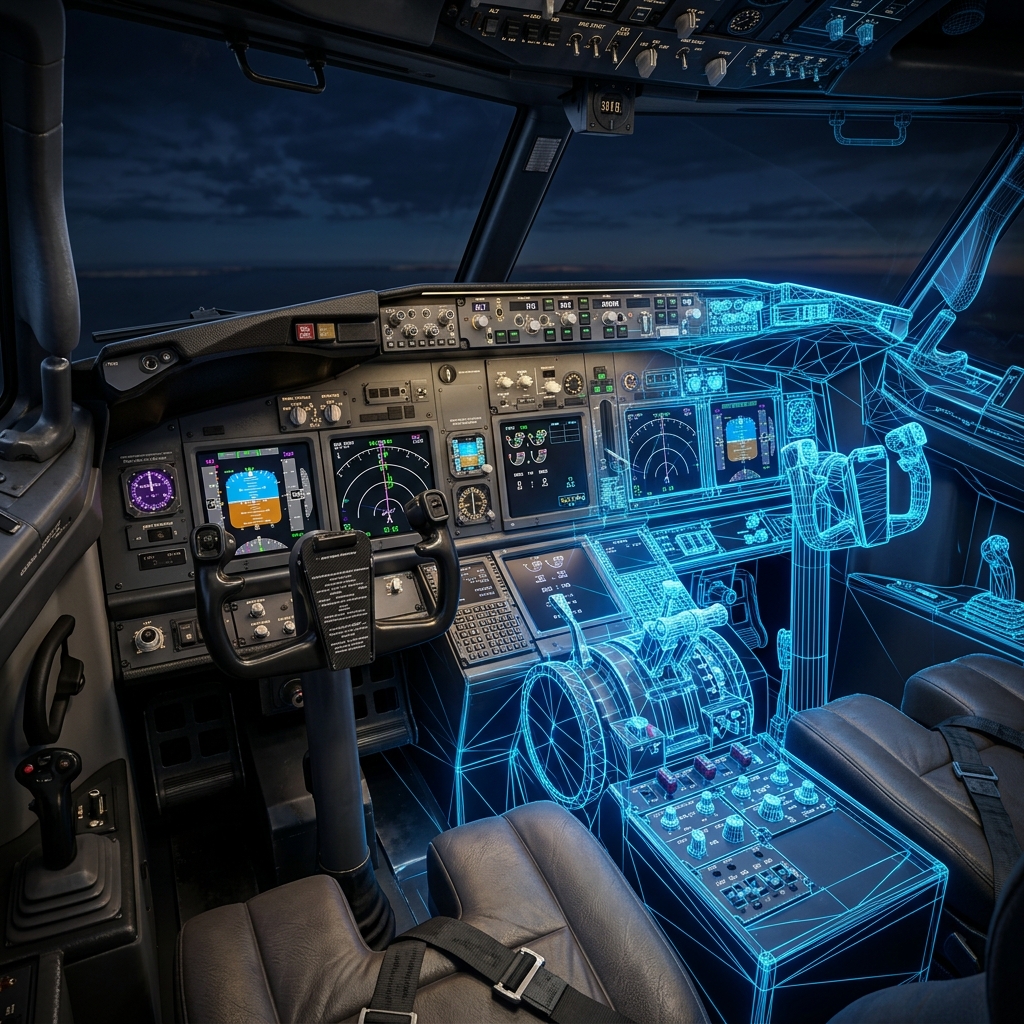
While 3D modeling is heavily utilized in product advertisement and real estate visualizations, its highest engineering threshold exists within industrial and flight simulation. Recreating the cockpit interior of a commercial rotor-wing aircraft or a complex mechanical assembly line demands absolute mathematical precision. A visually stunning render is insufficient—the digital twin must perform and react identically to its real-world counterpart.
Key Takeaways (TL;DR)
- Industrial simulation requires 1:1 hardware measurement scale, utilizing vernier calipers and CAD data transplants.
- Apex IT Solutions develops dynamic digital instrumentation—such as real-time PFDs (Primary Flight Displays)—that interface live within simulation engines.
- Highly optimized mesh topology is mandatory to ensure these massive digital twins render smoothly at 60FPS+ inside interactive environments.
How Is 3D Modeling Used for Industrial Training and Aviation Simulation?
Flight simulation developers and industrial training sectors require environments where physical interactions—flipping a battery master switch or programming a Flight Management System (FMS)—trigger accurate sequence logic within the game engine. To achieve this, the 3D asset must be rigorously built with strict hierarchy, isolated mesh components, and zero geometric collisions.
The Exacting Precision of Digital Twins
At Apex IT Solutions, our 3D engineering department approaches simulation modeling differently than standard architectural renders. We utilize precise measurement protocols (often reversing logic from hardware maintenance manuals) to model instrument panels like the Genesys IDU 680 to pixel-perfect accuracy. Every bezel, rotary knob, and emissive screen is unwrapped seamlessly and baked for optimized rendering without sacrificing visual fidelity.
Unreal Engine & Technical Implementation
Our deliverable is not just raw geometry. Our technical engineers rig and prepare these models for native integration into sophisticated environments like Unreal Engine 5 or proprietary flight simulators. We optimize the UV maps and texture atlasing ensuring the B2B client experiences zero framedrops during intense, computational simulation loads.
Enterprise Architecture Proof: Dive into our sophisticated 3D Modeling & Animation Production Services, or explore our interactive 3D assets deployed in the 3D Portfolio Integration.
your project into a success story.